Updated On: 20 Aug 2026
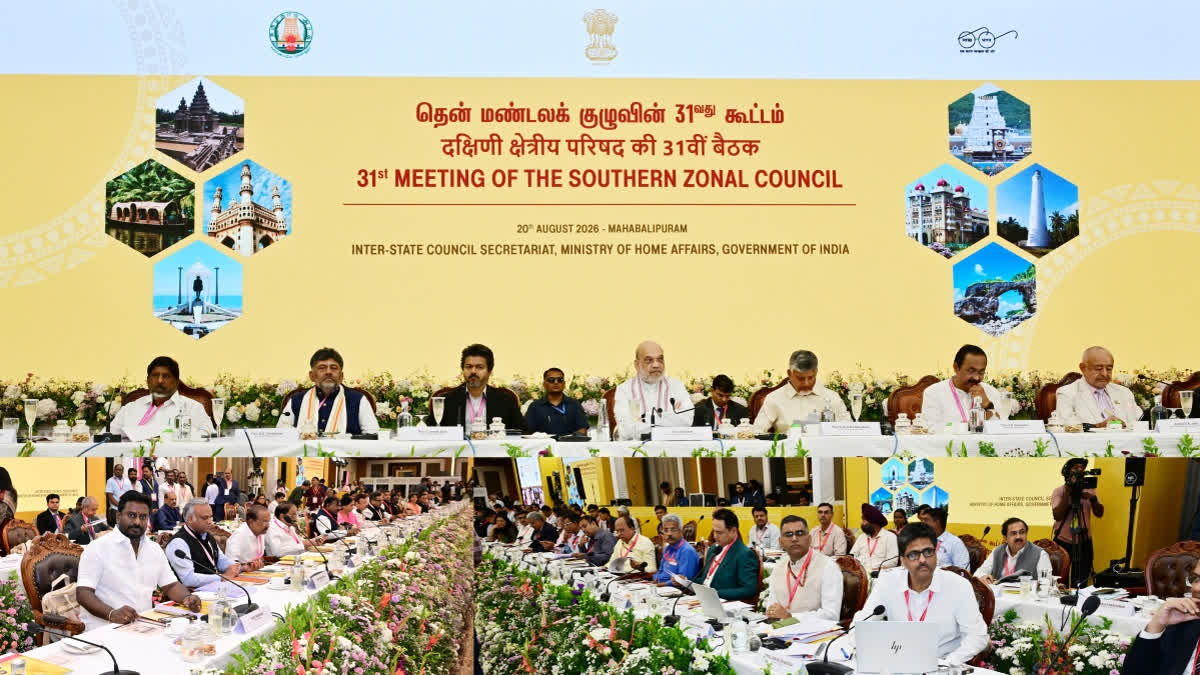
MAHABALIPURAM: Delimitation, protection of the southern states’ political representation, NEET, Cauvery water-sharing and greater fiscal autonomy dominated discussions at the Southern Zonal Council meeting chaired by Union Home Minister Amit Shah in Tamil Nadu on Thursday.
Karnataka Chief Minister DK Shivakumar sought a formal resolution to protect the South’s parliamentary strength, while Tamil Nadu Chief Minister Joseph Vijay called for safeguards against any reduction in the region’s political representation following the proposed delimitation exercise.
The meeting also focused on cooperation among southern states on river-water management, transport, logistics, coastal security, drug trafficking and disaster response.
Vijay sought exemption for Tamil Nadu from NEET and proposed that MBBS, BDS and AYUSH admissions under the state quota be based on Class 12 marks, arguing that the examination disadvantages rural and socially and economically weaker students.
CM VIJAY SEEKS SAFEGUARDS ON DELIMITATION
Vijay said states that successfully implemented population stabilisation policies should not lose political representation as a consequence. He noted that the freeze on Lok Sabha seat allocation based on the 1971 Census was nearing its end and expressed concern that population-based delimitation could reduce the South’s collective parliamentary voice.
He sought a legislative assurance from the Centre that no state would lose its share of parliamentary representation because of its success in population stabilisation.

“The Southern States have been at the forefront of population stabilisation, human development and economic growth. These achievements reflect the successful implementation of national priorities and should not result in a reduction of our representation,” Vijay said.
He also called for safeguards to ensure delimitation did not weaken the South’s political influence or the federal balance.
On NEET, Vijay reiterated Tamil Nadu’s opposition to the examination, saying it disadvantages rural and weaker sections and undermines the state’s school education-based admission model.
He also sought stronger inter-state coordination on drug trafficking, economic and logistics clusters, maritime growth, the blue economy and coastal security.
CM SHIVAKUMAR SEEKS PROTECTION OF SOUTH’S POLITICAL VOICE
Shivakumar called for a Southern Zonal Council resolution protecting the region’s parliamentary representation. He urged the Centre to continue using the 1971 Census as the basis for delimitation, retain the Lok Sabha’s existing strength of 543 seats for the next 25 years and accommodate women’s reservation within the existing number of seats.
“We welcome the assurance that no southern state will lose seats. But representation is not only about numbers. It is about weight and about voice,” he said.
Shivakumar argued that southern states should not be penalised for successfully implementing population stabilisation policies and said their economic weight must be matched by political representation.
He also sought restoration of Karnataka’s tax share from 3.6% to 4.7%, saying the reduction under the 15th Finance Commission caused an estimated loss of Rs 65,000 crore over six years. He sought Rs 5,495 crore in special grants and Rs 6,000 crore in state-specific grants recommended by the commission.
On water disputes, Shivakumar called for a shift from water sharing to water cooperation based on equity and transparency while protecting Karnataka’s lawful share and the rights of other riparian states.
Backing the Mekedatu project, opposed by Tamil Nadu, he said, “Every drop of water from the Mekedatu project will help farmers in Tamil Nadu and Puducherry. Help us help you.”
He also raised drug trafficking, healthcare, education, nutrition, housing, coastal erosion, mining rights, justice delivery, digital infrastructure, banking and farmer support.
KERALA OFFERS WATER FROM NEW MULLAPERIYAR DAM
Kerala Chief Minister VD Satheesan raised healthcare financing, coastal erosion, rail connectivity, night traffic restrictions and inter-state security.
On Mullaperiyar, Kerala assured Tamil Nadu that it would provide all water from a new dam if Tamil Nadu agrees to the proposal. Kerala offered to bear the project cost and suggested that Tamil Nadu determine its design, construction and location.
Kerala sought cooperation to develop the state as a port hub under Mission Samudra and opposed the proposed mining law amendment, saying mineral-bearing states should retain their fiscal rights.
It favoured one-third reservation for women without increasing Parliament’s overall strength. Kerala also raised concerns over Ayushman Bharat PM-JAY, saying it spent around Rs 1,493 crore under the scheme in the last policy year but received about Rs 151 crore from the National Health Authority.
Kerala sought disaster funds for coastal protection and rehabilitation of families displaced by erosion and called for a national policy on coastal erosion. It also opposed blanket night traffic restrictions on forest highways linking Kerala with Karnataka and Tamil Nadu.
CM NAIDU PUSHES GODAVARI-CAUVERY LINK
Andhra Pradesh Chief Minister Chandrababu Naidu called for stronger cooperation among southern states, saying they collectively contribute around 31% of India’s GDP and could build a USD 10-trillion economy by 2047.
He sought resolution of pending Andhra Pradesh bifurcation issues and highlighted Polavaram, the South Coast Railway Zone and Amaravati.
Naidu proposed diverting more than 500 TMC of water through the Godavari-Cauvery link, saying it could provide a long-term solution to Tamil Nadu’s water needs. He also sought coordination among Andhra Pradesh, Telangana, Karnataka and Tamil Nadu on water management.
He proposed a Ganga-Cauvery river-linking plan, a bullet train corridor connecting Andhra Pradesh, Karnataka and Tamil Nadu through Kuppam, an integrated transport system linking Amaravati, Bengaluru and Chennai, and common logistics networks and dry ports.
TELANGANA SEEKS STRONGER REGIONAL COOPERATION
Telangana Deputy Chief Minister Bhatti Vikramarka Mallu stressed greater cooperation among southern states on shared priorities and regional development.
Mallu said Telangana remained committed to strengthening coordination among the states and contributing to a stronger India. He held discussions with chief ministers, deputy chief ministers, ministers and senior officials during the meeting.
The state emphasised collective efforts on common economic, infrastructure and development priorities, with stronger regional coordination seen as important to addressing shared challenges.
The meeting brought together political, economic and inter-state concerns, with southern states stressing that the region’s contribution to India’s economy should be matched by political representation, fiscal fairness, infrastructure support and a stronger voice in national policymaking.