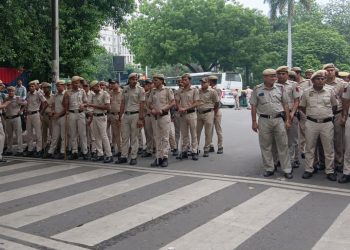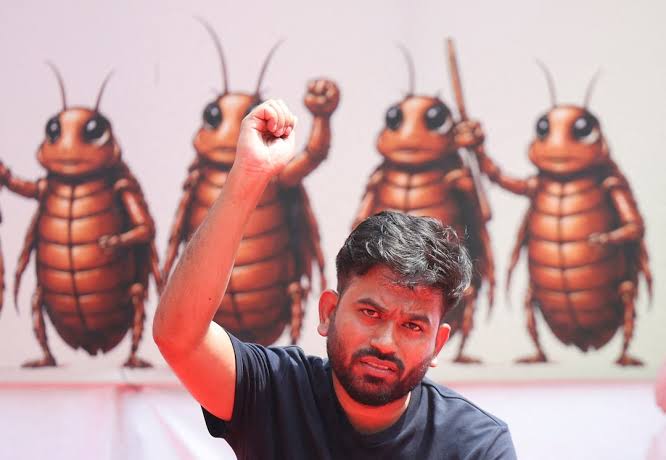
NEW DELHI: The founder of India’s “cockroach” protest movement, Abhijeet Dipke, has been detained by police in Delhi ahead of a planned march in the heart of the capital. His detention follows a police warning against holding Friday’s march, with thousands of security personnel deployed across the city to prevent the gathering. Dipke’s youth-led Cockroach Janta Party (CJP), which has drawn thousands onto the streets in recent months, is demanding the resignation of India’s election chief over a controversial revision of voter lists. The Election Commission denies this. The group had asked supporters to come to a park in Connaught Place, one of Delhi’s busiest commercial districts, to wave the Indian flag. Dipke was just moments away from reaching his vehicle police officers surround him and force him into a police car. Some CJP supporters tried to block the vehicle from leaving. Anish Gawande, the opposition politician at whose house Dipke had been staying, questioned why police had detained him. Police have not yet publicly confirmed the grounds for the detention. “Detaining a lone man walking with the national
flag in his hand is a bit of a joke,” Gawande said. It was the second time in less than a week that Dipke had been detained. Last Saturday, police boarded his plane shortly after it landed in Delhi and took him away before he could reach a planned demonstration. Police barricades and mass detentions prevented thousands of other protesters from reaching the venue. Dipke was released the following day, but two other CJP leaders were later jailed for five days after entering Jantar Mantar, a protest site recently declared off-limits by police. Friday’s march was partly show solidarity with the intended two jailed leaders. Dipke had acknowledged the possibility of being arrested again. In a video message on Thursday, he urged supporters unable to travel to Delhi to raise the Indian flag in their own towns and cities. “I also may be jailed after this, but I am not worried. Tricolour is my pride and I will raise it,” he said. Earlier on Friday, police had served Dipke with a notice warning him against holding the march without permission.
Authorities also closed Central Park for two days, citing “administrative reasons”. Police offered to let a small group wave the national flag and sing the anthem at another location. The CJP responded by changing its plans, urging supporters to enter Connaught Place in groups of fewer than five, unfurl the flag, take a photograph and leave. Waving the Tiranga is not a crime,” the group said in a social media poster, using the Hindi name for India’s tricolour flag. It encouraged supporters to share their photographs online. By the time the protest was due to begin, around 200-300 people had gathered near Central Park. Prevented by police from entering, they moved around the park, waving flags and shouting slogans. The atmosphere grew tense at times, although police appeared to be exercising restraint. The turnout was far smaller than at earlier CJP demonstrations. Security personnel, meanwhile, continued to arrive. More officers emerged from buses stationed around Connaught Place, joining the thousands of police and paramilitary personnel already deployed. Journalists also crowded the streets, with police and media appearing to far outnumber the protesters. Barely five months old, the CJP began as an online campaign in May after India’s chief justice likened some unemployed young people to cockroaches. Dipke embraced the insult and turned it into a rallying cry. By July, the group had become a formidable force, drawing thousands of young people into protests over leaked examination papers. A march towards Parliament in July descended into clashes with police, bringing the movement wider attention and intensifying pressure on the government. The unrest eventually forced the resignation of India’s education minister, Dharmendra Pradhan. Police cited earlier demonstrations in their warning against Friday’s march.