New Delhi Declaration condemns Pahalgam terror attack, rejects unilateral sanctions and protectionism; Modi holds key bilateral meetings with Xi, Putin, Pezeshkian and Gulf leaders
Updated On: 12 Sep 2026
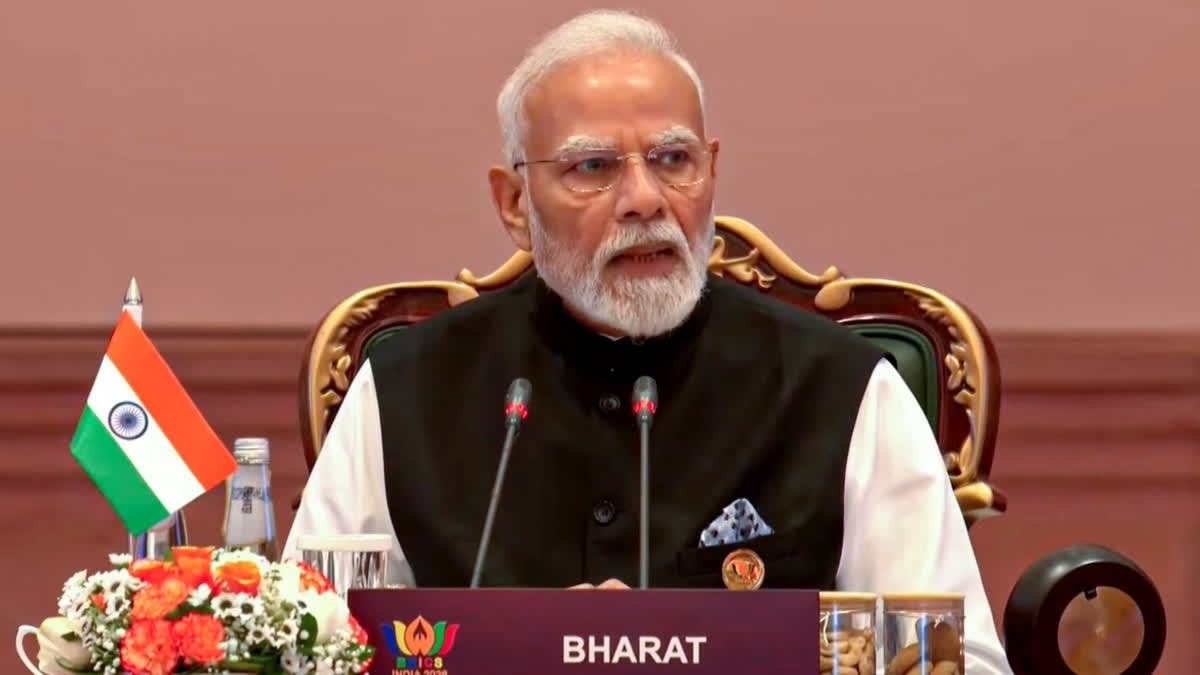
NEW DELHI: In a major diplomatic breakthrough, BRICS leaders on Saturday adopted the New Delhi Declaration by consensus, overcoming differences among member countries on contentious geopolitical and economic issues, including tensions involving Iran, Saudi Arabia and the UAE.
The declaration, adopted at the 18th BRICS Summit at Bharat Mandapam, took a firm position against terrorism, unilateral economic sanctions and growing protectionism, while calling for stronger multilateral cooperation and reforms to the global trading system.
The two-day summit, being held on September 12-13 under India’s chairship, brings together leaders of the expanded BRICS grouping amid continuing conflicts, geopolitical tensions and uncertainty over global trade.
A key highlight of the declaration was its strong condemnation of the April 22, 2025 terror attack in Pahalgam, Jammu and Kashmir, in which 26 people were killed.
“We condemn in the strongest terms the terrorist attack in Jammu and Kashmir on 22 April 2025,” the declaration said, while reaffirming the grouping’s commitment to combating terrorism in all its forms, including cross-border movement of terrorists, terror financing and safe havens.
The leaders stressed that terrorism cannot be associated with any religion, nationality, civilisation or ethnic group and called for those involved in terrorist activities and those supporting them to be brought to justice. They also called for “zero tolerance” towards terrorism and rejected double standards in counter-terrorism efforts.

The declaration welcomed the work of the BRICS Counter-Terrorism Working Group and urged faster progress towards the proposed Comprehensive Convention on International Terrorism, an initiative first put forward by India at the United Nations in 1996.
Strong message on sanctions, protectionism
The BRICS leaders also strongly opposed unilateral economic sanctions and secondary sanctions imposed outside the authority of the UN Security Council, arguing that such measures violate international law and the UN Charter.
The declaration expressed concern over the growing use of tariffs, non-tariff barriers and trade restrictions, including measures introduced under environmental pretexts. BRICS warned that such protectionist policies could disrupt global supply chains, increase economic uncertainty and disproportionately affect developing countries.
The grouping called for efforts to make the World Trade Organisation more responsive to global trade disruptions while ensuring that the interests of emerging markets and developing economies remain central.
The leaders also highlighted the negative humanitarian consequences of unilateral restrictions, particularly their impact on food security, healthcare and economic development.
Modi steps up bilateral diplomacy
Prime Minister Narendra Modi held a series of bilateral meetings with visiting leaders on the sidelines of the summit, including Chinese President Xi Jinping, Ethiopian Prime Minister Abiy Ahmed Ali, Malaysian Prime Minister Anwar Ibrahim and Abu Dhabi Crown Prince Mohamed bin Zayed Al Nahyan.
Modi’s meeting with Xi was among the most closely watched engagements of the summit. Xi arrived in New Delhi on Saturday for the BRICS gathering, marking his first visit to India in nearly seven years.
On Friday, Modi held separate meetings with Iranian President Masoud Pezeshkian, Russian President Vladimir Putin and UN Secretary-General António Guterres.
The diplomatic engagements come against the backdrop of continuing geopolitical tensions and underline India’s efforts to use its BRICS chairship to build consensus among countries with sharply differing strategic interests.
Push for local currencies, digital payments
Economic cooperation remained another major focus of the summit. During the BRICS Business Forum on Friday, Commerce Minister Piyush Goyal urged member countries to connect their national digital payment networks and strengthen cross-border transactions.
BRICS members are also working towards mechanisms to facilitate direct trade settlements in local currencies, reducing dependence on the US dollar and making cross-border payments faster, cheaper, safer and more transparent.
Addressing the Business Forum, Modi outlined the roadmap of “Make in India, Innovate with India, Scale for the World”, while proposing the removal of the top 10 trade barriers among BRICS countries and the creation of a pipeline capable of scaling 100 cross-border startups every year.
India’s fourth BRICS chairship
India assumed the BRICS chairship on January 1, 2026, for the fourth time after holding the position in 2012, 2016 and 2021. This year also marks two decades since the establishment of BRICS.
Under India’s chairship, more than 350 meetings and high-level engagements have been conducted across more than 25 cities.
BRICS originally comprised Brazil, Russia, India, China and South Africa. Egypt, Ethiopia, Iran, the UAE and Saudi Arabia joined in 2024, while Indonesia became a member in 2025. Belarus, Bolivia, Kazakhstan, Cuba, Malaysia, Nigeria, Thailand, Uganda, Uzbekistan and Vietnam joined as partner countries last year.
The 2026 summit is being held under the theme “Building for Resilience, Innovation, Cooperation and Sustainability”, with leaders focusing on trade and investment, technology, food and energy security, healthcare, disaster resilience and critical supply chains.
With the New Delhi Declaration now adopted despite significant differences among members, India has secured a key diplomatic outcome from its BRICS chairship while placing terrorism, economic sovereignty and a more inclusive global trading system at the centre of the grouping’s agenda.